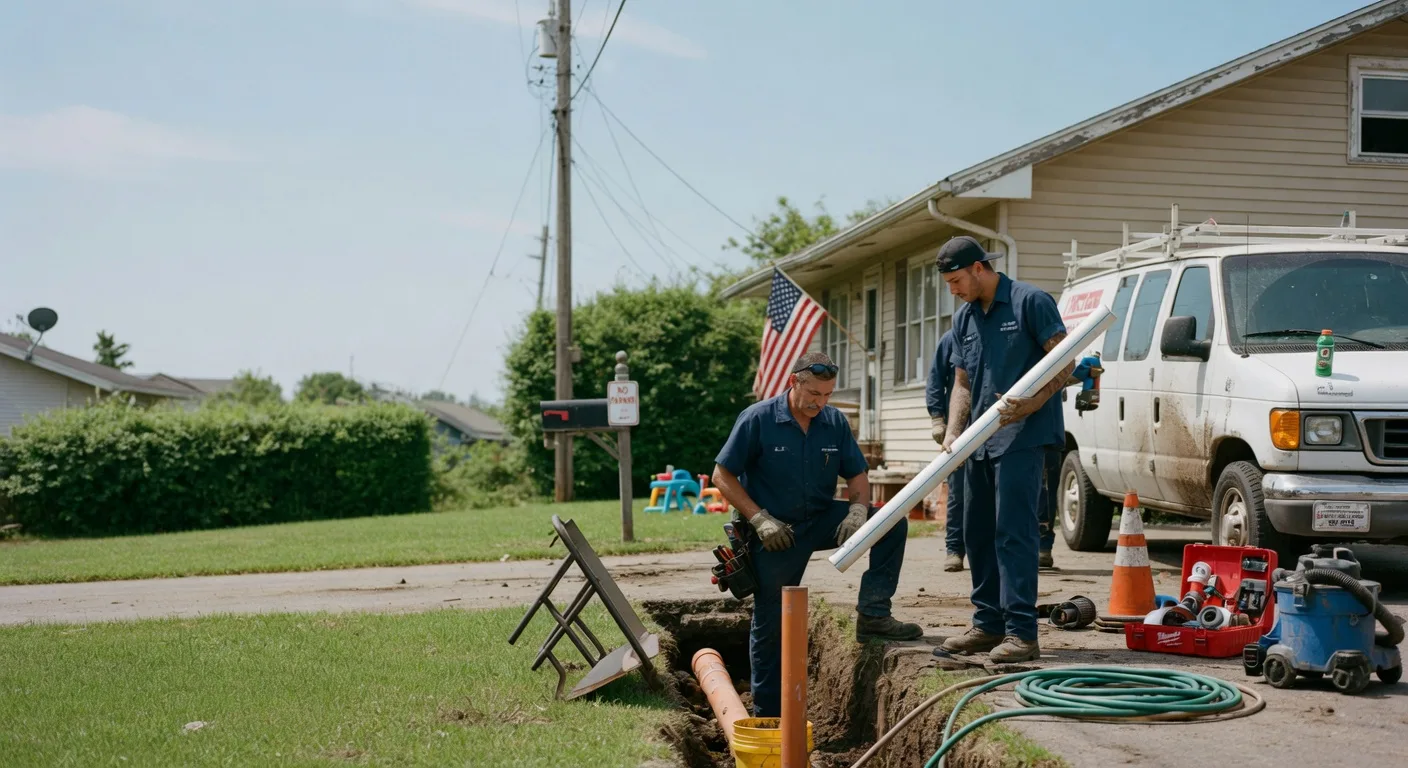
What is the difference between a septic system and a city sewer line for drain problems?
The two systems fail in different places, so the first job is knowing which one your home has. A city sewer line carries wastewater from your house to a municipal main, so trouble is usually confined to the pipe: roots at a clay joint, a bellied section, scale in old cast iron, or a blockage in the lateral. Every drain in the house backing up at once typically means the private line or the connection at the street. A septic system adds a buried tank and a drain field. Solids settle in the tank, and liquid flows out through perforated pipe into the soil. Slow drains or backups can mean a tank that is full and overdue for pumping, a clogged outlet filter or baffle, a failing drain field that can no longer absorb water, or a blockage in the short line between the house and the tank. Soggy ground or a strong odor over the tank area points away from the house plumbing. A cable machine or hydro jetting can clear the house line on either system, but jetting into a septic line needs care about where the water and debris end up. Property paperwork, a cleanout location, or the water utility can tell you which system you have. Expert Plumbers Co connects homeowners with an independent local plumber who works on that type of system.
Homeowners often assume a septic problem and a city sewer problem look the same from the bathroom, but there are a few quick clues. On city sewer, a backup after heavy use is usually the private line or the lateral at the street, and neighbors on the same main may have had the same trouble. On septic, the problem tends to build slowly: drains slow down across the house, the toilet flushes weakly, and a patch of lawn stays wet or unusually green. A common mistake is pouring additives into a septic tank hoping to fix a failing drain field. They do not repair soil that has stopped absorbing water. When you call, tell the plumber how old the system is, when the tank was last opened, and where the cleanout or lid sits. In older homes the tank may be buried deeper than expected and need to be located first, which adds time before any repair starts.
Why did the clog come back worse after I used a store-bought drain snake?
You ran a snake from the hardware store, the water moved for a day, and now the sink is worse than before. That is common, and it comes down to the tool.
A thin hand-crank snake often punches a small hole through the middle of a clog. Water trickles through, so it seems fixed. The clog is still there, and it gets packed tighter as new debris catches on it. Sometimes the snake pushes the clog deeper into a bend, where it is harder to reach. A snake also does not scrape the pipe wall, so the grease build-up stays and the clog forms again quickly.
It is the wrong tool for roots, a bellied line holding water, or scale in cast iron. Those need a heavier cable with a cutting head, hydro jetting, or a camera inspection to see what is actually in the pipe.
Safe homeowner check: place a bucket under the trap, remove it and clear it by hand. Do not add chemical cleaners after snaking, because the plumber may then be working in caustic water.
Stop running water and call if the snake stuck or will not come back out, if other drains gurgle or back up, or if you smell sewage. That points past a single fixture to the main line.
Cost depends on access, what is found, and how much has to be opened up. Expert Plumbers Co is a referral service. Call (380) 262-9173 for Drain Cleaning help from a plumber serving Cambridge, ME.
After a failed snake attempt, leave the fixture alone and tell the plumber exactly what you did: the type of snake, how far it went in, whether it hung up, and whether you used any chemical cleaner first. That saves time on site and tells them whether the cable is still stuck or the clog was pushed into a bend. Do not keep running the snake in the hope that it will break through. Forcing a thin cable through a trap or a sharp bend can scratch the pipe wall or damage the trap, and in old cast iron it can knock loose scale that adds to the blockage. Also stop using the sink for a few hours if you can, because the extra water tends to carry loose debris deeper. Expect the proper clearing to include a look at the pipe wall afterwards, so you know whether this was a one-off blockage or a pipe that keeps catching debris.
There is a soggy strip, a sinkhole or an unusually green line of grass over where my sewer runs. Is that a broken sewer line?
It can be. A wet strip, a dip in the lawn or a stripe of grass that is greener than the rest, all following the path of the sewer, is a classic sign that the pipe is leaking into the soil. Waste water carries nutrients, so the grass above it grows lush while the ground underneath stays soggy.
A sinkhole is more serious. If soil is washing into a cracked or separated pipe, it leaves a void that grows over time. The surface may look fine until the roof of that void gives way. Keep people, pets and vehicles off the area and do not fill it yourself with a quick load of dirt, because the hole will usually return.
Other things can look similar, so check before assuming. A leaking irrigation line, a broken water supply pipe or a downspout discharging at that spot can all soak a strip of lawn. A simple test: shut off every tap and appliance, then look at your water meter. If it keeps moving, the leak is likely on the supply side, not the sewer. If the meter is still, and you also notice slow drains, gurgling, a sewage smell outdoors or backups, the sewer is the stronger suspect.
Safe checks you can do:
Note where the wet or green strip runs and whether it lines up with the cleanout or the path to the street. Reduce water use until the line is looked at.
Stop running water and call now if sewage is surfacing, a hole is opening, or drains inside the house are backing up.
Cleaning alone does not fix a broken pipe. A camera inspection is how a plumber finds the break, shows how far the damage runs and tells whether the pipe is cracked, offset at a joint or collapsed. Repair can then be a spot repair, a liner through the existing pipe, or replacement of a section. Cost is driven by depth, length of pipe affected, what sits on top of it such as a driveway, trees or a patio, how much has to be excavated, the pipe material and permits under local code. To be connected with an independent local plumber in Cambridge, ME, call Expert Plumbers Co on (380) 262-9173.
Can I rent a hydro jetter or a big drain machine and do the main line myself?
"Can I just rent a hydro jetter and do the main line myself?" You can rent one at many tool shops, so it is a fair question. The honest answer is that it is a bad bet on a main line, for reasons of both pipe and safety.
A hydro jetter pushes water at very high pressure through a hose with a nozzle that pulls itself down the pipe. In the right hands, on sound pipe, it cleans grease and scale off the pipe wall. In the wrong hands it can break old clay or cast iron, wash out joints, drive water into a cracked pipe, or punch through a thin spot. Root intrusion at a clay joint can hold the nozzle, and a bellied line can trap it.
A large drain machine has its own risk. The spinning cable can whip, snag and twist. It can wrap a hand or arm in a second.
There is a bigger issue. Without a camera, you do not know what you are cutting. A main line that backs up may be roots, a bellied line, a collapsed section or a failed sewer lateral. Clearing the blockage may only open a hole through it, and it returns soon after.
Safe homeowner check: Run one fixture at a time and note which drains slowly. Check if it is one fixture or every drain in the house. Do not pour drain chemicals into a line that is backing up.
Stop running water and call now if sewage is coming up in a tub, shower or floor drain, the toilet bubbles or rises when you run other fixtures, or you smell sewage in the house. Stop using water in the house until the line is cleared.
A cable machine is enough for a simple clog in a branch line. Hydro jetting is for grease and scale on the pipe wall. A camera inspection is the step that tells the plumber what is in the pipe and what tool is safe to use, which is what a rental cannot give you.
Expert Plumbers Co is a referral service. We connect you with an independent local plumber in Cambridge, ME. Call (380) 262-9173.
Ask the plumber to show you the camera footage and explain what was found. Ask whether the pipe is sound enough for jetting. Cost depends on access to a cleanout, the parts or materials needed, how much has to be opened up or removed to reach a damaged section, and any permit or code requirement.
Our walk-in shower has a long linear drain and it keeps backing up. Why?
Your walk-in shower has that long, slim linear drain along one wall or the back edge, and it keeps backing up. The water rises around your feet, drains slowly, then does it again a week later. There are a few reasons a linear drain behaves this way.
The channel is long and shallow, so it collects hair and soap scum along its whole length. Many linear drains also have a small outlet at one end or in the middle, often undersized compared to the flow from a large shower head. If the pan is built with a low slope toward the drain, water crawls instead of running, which leaves scum behind and lets hair settle. Under the cover, the trap or the first section of pipe can also fill with hair, so the channel looks clean and still backs up.
If only the shower backs up and the sink and toilet in the same bathroom are fine, the problem is the channel, its outlet, the trap or the shower branch. If other fixtures are slow or gurgling, or water shows in a floor drain, the line further down is involved.
Safe homeowner check: lift out the grate or cover and clean the channel with gloves. Look at how water moves across the floor, because standing water on the pan suggests a slope problem rather than a clog alone. Skip chemical openers.
Stop running water and call now if sewage or gray water comes up elsewhere, if you see moisture on the ceiling or walls below the shower, if the floor around the shower feels soft, or if a sewer smell comes with the backups. A leaking pan is a different problem from a clog and can damage the structure.
A cable machine is usually enough for hair and soap in the trap or short branch, though the plumber must be able to get past the channel outlet. If the problem keeps coming back, a camera inspection can show a belly, offset or roots beyond the shower. Hydro jetting may be proposed when the pipe wall is coated with grease or scale.
Expert Plumbers Co is a referral service. We connect you with an independent local plumber in Cambridge, ME. Call (380) 262-9173.
Ask the plumber whether the cause is the drain body, the slope of the pan or the pipe beyond it. If the slope or outlet is the problem, ask what it takes to correct it. The scope depends on access to the drain, the parts or materials needed, how much tile or floor has to be opened up, and any permit or code requirement.